
A laboratory can make a successful technology investment without saving money in the laboratory. The reason is simple: some of the value may appear somewhere else.
Yet when we evaluate an investment, we naturally start by looking at the laboratory itself. Has manual work been reduced? Has capacity increased? Are processes faster? Has the investment lowered operating costs?
These are reasonable questions. But they may not tell us where the most important value actually appears.
The investment is local. The value may not be.
Consider a relatively simple example.
A change in laboratory workflow makes a clinically important result available earlier. Inside the laboratory, the improvement may look modest. The same professionals are working, the same equipment is runningand the same number of samples may be processed.
But somewhere else in the hospital, something has changed. A clinician can make a decision earlier. Treatment can proceed sooner. A patient may spend less time waiting for the next step.
None of those benefits necessarily appear in the laboratory budget. This creates a problem when digital investments are evaluated primarily within organizational boundaries. The department carrying the cost may not be the department receiving the largest benefit. We may therefore be measuring digital investments where the cost occurs, rather than where the value appears.
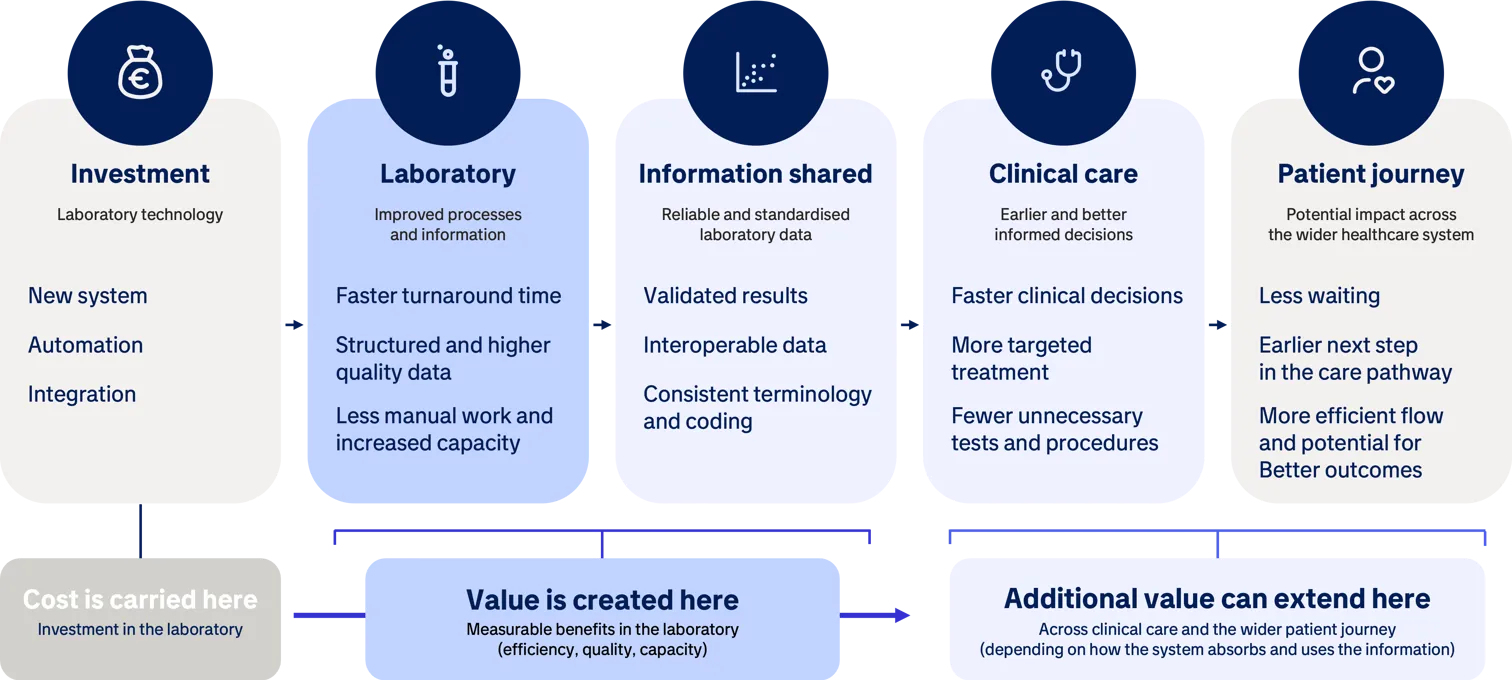
The investment is made in the laboratory. Value can be created there — and additional value may be realized further along the patient journey.
Following the flow, not only the technology
Laboratory work rarely ends at the laboratory door. A sample moves through registration, preparation, analysis, validation and reporting. The resulting information then becomes part of another process: diagnosis, treatment, medication, surgery, discharge or further investigation.
Improving one part of this chain can influence several others. But making one laboratory step faster does not automatically make the patient journey faster. If the next part of the process cannot absorb the increased capacity, the queue simply moves.
This is why turnaround time, automation rates and reduced manual steps are useful measures, but not sufficient measures of value on their own.
We also need to understand what happens next.
A different way to look at the business case
If value can extend beyond the laboratory, the business case should reflect that. This means asking three questions:
- Where is the cost carried?
- Where is the value expected to appear?
- How will we know whether that value was actually realized?
EHDS extends the perspective
The European Health Data Space adds another dimension. As health information becomes increasingly available for use across systems, organizations and national borders, exchanging the data is only part of the challenge. Information also needs sufficient structure, quality and context to remain useful when it reaches somewhere else.
For laboratories, this is particularly relevant.vDifferences in terminology, coding, local configurations and system implementations can make apparently similar information difficult to reuse consistently. Creating a stronger foundation therefore requires investment in structured data, interoperability, traceability and reliable integrations.
EHDS broadens the impact of these investments. Laboratory information will increasingly need to remain understandable and useful beyond the system, organization or even country where it was originally produced. This makes the quality and structure of laboratory data part of a much wider healthcare infrastructure.
From requirements to problems
Healthcare technology often starts with requirements: a new feature, an integration or an automated step. But a requirement describes what we want the system to do. It does not always tell us enough about the problem we are trying to solve, or what should actually improve as a result.
A solution can meet the agreed requirements, pass validation and work as intended, while the underlying problem remains.
Before deciding what to build or buy, we should therefore ask:
- What problem are we actually trying to solve?
- Where in the workflow does it occur?
- What happens before and after it?
- What should be measurably different when the change is complete?
Answering those questions requires laboratory professionals, clinicians and other users of laboratory services, IT and technology providers to look at the same process together — and to continue doing so after implementation.
Successful delivery is not the same as realized value
Delivering reliable, validated and safe functionality according to specification is essential. But successful delivery and realized value are not necessarily the same thing.
For technology providers, our responsibility should therefore not end when the solution is delivered. We also need to understand whether it actually improved the workflow and created the value we expected.
And we need to remain curious after implementation. Did manual work actually disappear, or did it move somewhere else? Did faster processing lead to faster decisions, or simply create another queue? Did better access to information reduce duplication? Did something meaningful change further along the patient journey?
This does not necessarily require a complex measurement framework. It can start by defining the expected change before implementation and measuring whether that change occurred afterwards.
In practice, laboratory workflows illustrate why this matters. A change may make a lab-result available earlier, but the value is only fully realized if that information also reaches the right professional in time to influence the next decision. Measuring turnaround time alone would capture the improvement in the laboratory, but not necessarily whether anything changed further along the patient journey.
Those questions are harder than asking whether the functionality works. They are also closer to the reason the technology was introduced in the first place.
Looking beyond the laboratory
The laboratory should remain accountable for its own investments, resources and priorities. Not every improvement can be justified by a broad claim about downstream value. But modern healthcare is too interconnected to evaluate every digital investment in isolation.
For laboratories, this means looking beyond whether technology made an individual process faster. For healthcare organizations, it means understanding what changed across the wider patient journey. And for technology providers, it means following the technology beyond delivery to understand whether it created the intended change.
Perhaps the next step in healthcare digitalization is not only becoming better at implementing technology. It is becoming better at following what happens after we implement it.
Where was the cost carried? Where did the value appear? And did we actually create the change we set out to achieve? For us as a laboratory technology provider, this is also shaping how we think about the future of laboratory systems: not simply as applications supporting individual processes, but as part of a connected diagnostic ecosystem where reliable information can move across the patient journey and create value beyond the laboratory.
Explore how we support laboratories and connected diagnostic workflows through our laboratory solutions.
