The 2025 AFP Treasury Benchmarking Survey Report reinforces this point. Nearly three-quarters of treasury practitioners cite cash management and forecasting as the top priorities of their department. The same research points to a clear difference between aspiration and capability since the most sophisticated treasuries employ automation for more than half of the liquidity forecasting process. The implication is clear - strategic treasury depends on the quality of the data, the strength of connectivity, and the extent to which manual processes can be replaced by automation.
62% of treasury practitioners say cash liquidity forecasting is the most challenging task
The issue is not that treasury teams lack ambition, but that they are often working with data that is fragmented, inconsistent, or difficult to access in the right format. Before treasurers can make better liquidity and working capital decisions, they must first be able to trust the data.
For banks, the call to action is clear. Fix the foundation: treat cash management data as an asset and invest in the information value chain
The Treasury Data Supply Chain and the Vital Role of Banks
Banks have invested heavily in digital banking, data file integration, and some AI-based forecasting solutions. However, many treasury teams still operate in a world of spreadsheets, broken data feeds, inconsistent file formats, and manual workarounds – and this complexity is multiplied across banking relationships. The result is a frustrating paradox because banks possess much of the data needed, but the data supply chain that delivers it is often not fit for purpose.
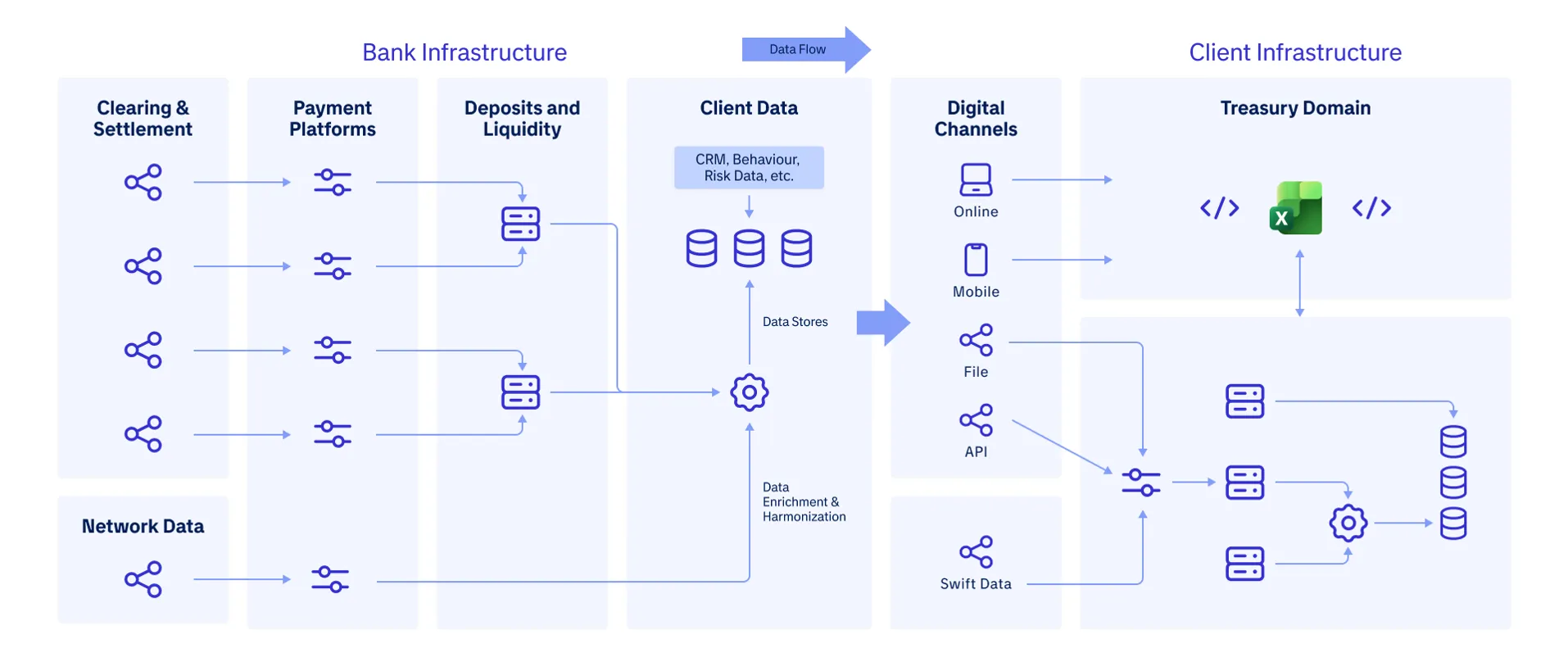
Illustrative Treasury Data Supply Chain, source: Celent
Celent contends that this transaction data remains an underutilized asset for developing next generation solutions and advisory insights. However, many banks continue to treat data as a by-product of transactions rather than as a strategic asset.
Contextual Data Orchestration is the key ingredient of success in AI strategy, plus offerings like VAM and In-house banking are effective tools for orchestration
Priority Investments Leave Data Behind
33% of corporate banks say digital channels are a top product priority
Celent Dimensions Surveys asked over 400 bankers worldwide about their technology and product priorities. As the “window to the bank” corporate digital channels remain a top priority. At least, that’s the stated ambition, but the survey suggests that data investments to support this are being left behind. Only 15% of banks stated that “cash and working capital data / insights” are a top product priority. In fact, this was the lowest ranked of 13 survey choices.
To change course, cash management data must be viewed as the foundation for intelligent solutions and more advisory treasury relationships. As initial steps, banks can immediately elevate their value if they provide data with the following characteristics:
- Consistent/centrally managed
- Rich and accurate
- Timely and historical
- Accessible across all channels
- Format flexibility
- Multi-bank capability
- API and file connectivity
- Enable value-add applications
Enabling Intelligent Treasury with AI, APIs, and ISO 20022
APIs are a key part of the modern treasury story. Pre-built connectors into ERP, TMS, and accounting platforms can reduce friction, while real-time data access can help companies anticipate liquidity needs. This is the enhanced value of APIs – they are ideal for integrating specific points in a business workflow – and are “on-demand” to deliver banking services to the point of need. However, ultimately the value comes from the data services delivered. Once in place, a strong data foundation allows AI to reliably support forecasting, exception detection, scenario analysis, liquidity optimization, working capital recommendations, and early warning indicators of potential fraud.
Celent advocates that ISO 20022’s richer data expands potential AI and analytics use cases. ISO 20022 is more than a format, it is an architecture for the future of financial messaging, and allows banks to create cleaner, richer, more consistent, and more globally usable treasury management data.
By considering ISO 20022 compliance as the floor rather than the ceiling, banks can redesign the information value chain and ask how they can transform richer data into better treasury outcomes. For example:
- Improve reconciliation
- Provide cleaner data into ERP and TMS environments
- Deliver enhanced receivables intelligence
- Help clients understand cash flow drivers and liquidity needs
Contextual Data Orchestration is the Key Ingredient for Success in AI strategy
With complex relationships and large volumes of data sitting in accounting and treasury systems, it is important to meaningfully organize the data in context to create seamless insights and actions. This is even more important in large corporate treasury functions that deal with multi-currency and multi-country operations. Tools like virtual accounts provide avenues to decipher complex data in context to improve operations. Moreover, offerings like in-house banking powered by virtual accounts offer a high level of self-service for corporates so they can set up and organize their receivables and payables tailored to their needs.
This orchestration further reduces the operational complexity and makes new Agentic AI operations seamless. This way, AI Investments can be used to solve complex and repeatable tasks without having to work on complex data which can be sorted out by cash management tools like VAM.
Call to Action
Banks are a critical part of the treasury data supply chain and have an outsized influence on treasury capabilities. When reliable rich data is in the right place at the right time, treasury can stop managing noise and start driving decisions.
The call to action for banks is to fix the foundation – the data supply chain – and enhance it with value-add solutions and tools that improve operations and insights.
- Treat cash management data as an asset
- Invest in the information value chain
- Make ISO 20022 a platform for value creation rather than a compliance milestone
- Use APIs to deliver data where treasury needs it
Banks that treat data as a product, as a client-facing asset, will be better positioned to deepen relationships and create new revenue opportunities.