
AI-enabled Manufacturing Execution Systems give mills the ability to replace guesswork with data, retain critical process know-how and improve performance with fewer resources. Increasingly, that is what separates leaders from laggards. That creates a clear but difficult choice. Investment may feel risky in a volatile market, but delay carries a cost.
Oversupply puts pricing under pressure, customer demand is shifting, and production runs are getting shorter. Sustainability expectations are rising, but profitability cannot slip. At the same time, a generation of papermaking expertise is leaving the industry, taking crucial operational knowledge with it.
In uncertain conditions, the mills that execute faster and run leaner are the ones most likely to strengthen their position.
Technology is now an operating priority
When the goal is to do more with less, technology has to carry more of the operational burden. Mills cannot replace the experts who leave, and few have the capacity to keep adding headcount.
That is why digital systems matter. They reduce dependence on scarce expertise, enable smaller teams to achieve more and help transfer operational knowledge before it walks out the door.
What a modern MES delivers
A Manufacturing Execution System, MES, links business planning with real-time production control. It gives a constant view of mill performance while improving execution across the order-to-cash process.
A strong MES supports the business as it operates today rather than imposing a rigid model. It centralizes planning, reduces manual work, cuts waste, and raises performance through better automation, optimization and decision support.
It also strengthens customer service. Orders from different channels flow faster and updates become more reliable. Fewer errors occur, and teams can use built-in tools to respond quickly without sacrificing efficiency.
Deployment flexibility reduces friction
A modern MES should align with both operating reality and capital strategy. That is why the strongest solutions offer multiple deployment options, including on-premises, customer-hosted subscription and fully managed SaaS.
Each model serves a different need: on-premises for maximum control, customer-hosted subscription for infrastructure ownership with flexible licensing, and SaaS for lower operating effort and predictable cost.
This flexibility allows companies to select the model that best supports their IT strategy, investment approach and long-term business goals.
AI is moving from insight to team member
The next step is decision support operating at machine speed. That is where AI starts to create measurable advantage.
Mills generate vast amounts of operational data, but data alone does not improve performance. AI can find patterns, convert signals into action and respond faster than manual processes. That makes it an irreplaceable tool for day-to-day operational improvement.
The most advanced MES platforms are now incorporating agentic AI. This moves the system beyond recommendation into controlled execution: using approved data, acting within defined limits, triggering tasks, and tracking outcomes against a target.
You can think of it as a new team member. You give it clear instructions, review its work, and guide it when needed. It can also be given access rights only where needed, just like any other employee.
The shift is already underway
Tieto’s new TIPS Web is a modern MES designed to sit between ERP and shop-floor automation, bringing these capabilities together in a practical operating model. It covers all MES requirements while supporting the realities of daily mill operations.
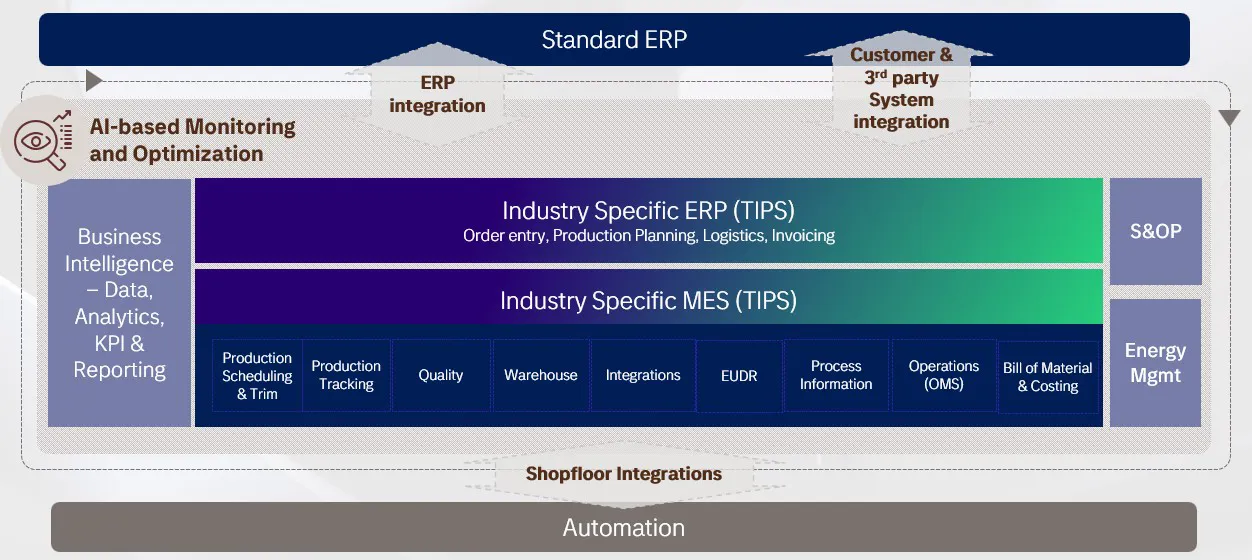
TIPS Operations Management System, OMS, consolidates production information in one place, including instructions, meeting records, root cause analysis, work permits, and anomaly tracking. Customer reports include exceptionally fast payback.
TIPS Costing adds visibility into standard and actual production costs, making savings easier to identify and capture.
The technology for AI-enhanced manufacturing execution excellence is already here. The strategic question is not whether to act, but how long you can afford to wait.
How can we help your business? Contact us, let's discuss! Visit also at tieto.com/tips
