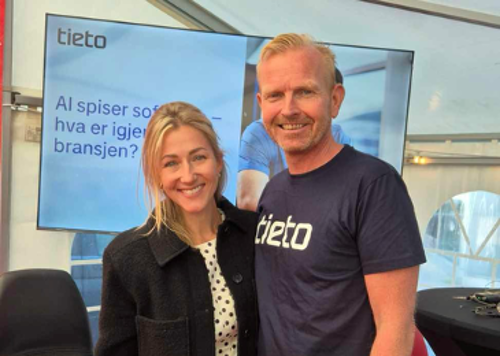
I'll be honest: I walked in with more questions than answers. I'll walk out of this blog post the same way. But at least I've tidied up the inside of my own head along the way — which is, perhaps, the one thing AI still can't do for us.
First: a number that won't let go
According to Anthropic's CPO Mike Krieger, Claude is now writing 100 % of its own code. AWS CEO Matt Garman estimates their number sits around 75 %.
A couple of years ago, this would have been science fiction. Today it's a footnote in a newsletter.
And that's where it gets interesting for us in IndTech: when code starts writing itself, what is it exactly that we're selling?
Three paradoxes I can't shake
1. We think we're faster than we are
Research institute METR measured developers using AI. The developers themselves estimated they worked 20 % faster. The data showed they worked 19 % slower.
Read that sentence again...
There's something almost touchingly human about it. We fall in love with the feeling of speed. We sit in the car, watch the speedometer, and forget to check whether we're actually heading in the right direction.
Veracode tested over a hundred language models and found security vulnerabilities in 45 % of AI-generated code. Newer models weren't safer. Google Cloud's DORA report put it perfectly: "AI doesn't fix a team; it amplifies what's already there."
If you have a good team, it gets better. If you have a chaotic team, you now have faster chaos.
2. We're automating away our own next generation
Harvard published a study last year showing that junior hires dropped 7.7 % in companies that adopted AI. Seniors? Unchanged.
We're removing the entry point to our own profession.
It might sound efficient right now. But ask yourself this: who's going to review AI-generated code in ten years, when today's juniors never became seniors?
A commenter on my LinkedIn post wrote something that's still rattling around in my head: "Those small, repetitive tasks weren't wasted time — they were a training ground."
He's right. And the training ground is disappearing while we clap our hands.
3. We're becoming world champions at consuming
According to Abelia, 55 % of Norwegian companies adopted AI in 2025. McKinsey found that only 5.5 % of companies extract real financial value from their investments. Gartner warns that over 40 % of agentic AI projects will be cancelled by 2027.
We talk a lot about the AI revolution. We talk less about who's actually building it. Spoiler: it's not us.
So what's left? Quite a lot, actually.
Here's where I surprised myself with my own optimism on the drive home from Kongsberg.
Because when I look at IndTech — and the rest of Tieto, for that matter — we have things that American hyperscalers can't copy over a weekend:
Domain depth. Healthcare, energy, finance, the public sector. Lifecare Smart Notes cuts documentation time for clinicians by up to 40 %. Not because our code is smarter than anyone else's. Because we understand what a clinician actually does all day. That kind of knowledge isn't something you can prompt your way to.
Trust and governance. Nordic data stewardship, traceability, transparency. In a world of agentic AI, this isn't a regulatory chore to sigh about — it's a competitive advantage we already have in our back pocket.
Orchestration over production. If code becomes cheap, the margins move. To architecture. To validation. To security. To making things actually work together. That's exactly where IndTech lives.
Modernizing the complex. IBM's watsonx customers report dramatically shorter analysis times in COBOL modernisation. That's where AI really delivers — at the intersection of computing power and deep domain knowledge. It's also an area where the Nordics happen to have a disproportionate amount of legacy code that needs renewing. That's not a problem. That's a market.
What does this mean for us in IndTech?
Three things I'm taking with me
1. We need to stop selling "AI" and start selling outcomes. No customer wakes up in the morning thinking "today I'm going to buy AI." They wake up thinking "we're bleeding margin on the billing side" or "we have a 14-day backlog in AR." That's where we come in.
2. We need to protect our juniors. Yes, AI does a lot of the work faster. But if we optimize away the tasks that teach people to think like engineers, consultants and advisors, then we're optimizing away tomorrow's seniors. That's not an HR problem. It's a strategic competence problem.
3. We need to dare to be boring where it counts. Governance. Traceability. Compliance. It's not sexy on a conference poster. But it's what makes customers choose us — and stay.
Finally
The best moment from Kongsberg wasn't the panel itself. It was the conversations afterwards, with people who came up and said "that thing you said about the juniors — that's something we're struggling with."
That's where we in Tieto IndTech can make a difference. Not because we have all the answers, but because we've been in this business long enough to remember that every single technology revolution has been overhyped in the short term and underestimated in the long term.
AI isn't the exception. It's the rule.
Code will get cheaper. That doesn't mean the value disappears. It just means the value moves — and our job is to move with it.
The same way we've been doing for 50 years.
PS: If you read this entire post without asking AI to summarize it for you first — congratulations. You're officially part of the resistance.