According to NVIDIA's fourth annual State of AI in Telecommunications survey, 89% of telecom companies plan to increase their AI budgets in 2026, up sharply from 65% just a year earlier. Telcos clearly believe the investment pays off: 90% of respondents say AI is already driving revenue growth while cutting costs, and when asked which AI use case delivers the best return, autonomous networks topped the list at 50% – ahead of customer service improvements (41%) and internal process optimization (33%).
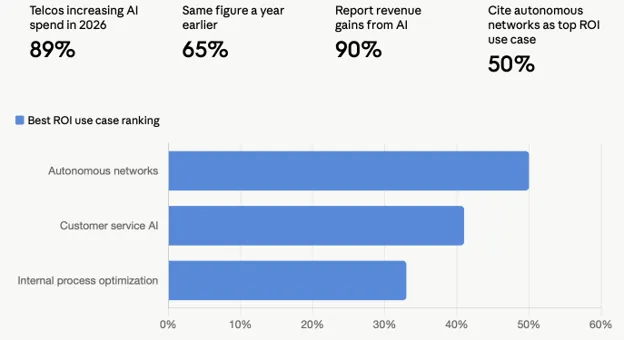
Yet most operators are still early in the journey. The same survey found that most companies report operating at TM Forum autonomy levels 1 to 3, well short of full autonomy.
So, what closes that gap between ambition and maturity? Based on extensive work across telecom operators, four elements consistently stand out as the building blocks every Telco needs in place before meaningful, lasting autonomy becomes possible.
1. A common ontology, backed by a robust inventory
Autonomous systems can't make good decisions about things they don't understand. That requires a common ontology – a shared, consistent way of describing and categorizing everything the control system needs to know and act on.
But an ontology on its own is just a vocabulary. What gives it substance is a robust, unified network inventory – a true "single source of truth." This inventory isn't a passive data layer; it's a living system that captures both the present state of the network and its intended state. Every process related to network management, manual or autonomous, depends on inventory data as an input – and just as importantly, every process needs to feed its outputs back into that inventory to keep it accurate.
The cost of skipping this step is well-documented. Analysis of Mason research cited by inventory specialists puts the annual cost of poor inventory accuracy, delayed provisioning, and redundant purchases at roughly $4.1 billion for U.S. operators alone. And the problem is only growing: Gartner predicts that by 2026, 80% of network functions in telecom will be virtualized, demanding far more sophisticated inventory tracking than most legacy OSS stacks were built for.
Think of it the way a human engineer treats network documentation: as the reference point for understanding how everything fits together. An autonomous system needs exactly the same thing, just structured for machine consumption – covering physical, logical, and virtual layers, and mapping relationships both horizontally (across domains) and vertically (across abstraction layers). This is the foundation of FNT Software's unified inventory solution that is purpose-built to provide, enabling connected control loops across multiple levels of abstraction.
2. Common service definitions
Different teams and systems often have subtly different ideas of what a "service" actually consists of – which is fine when humans are interpreting things contextually, but disastrous for automation.
A common service definition gives every process – provisioning, monitoring, billing, assurance – a shared understanding of what a service is supposed to deliver. Without this shared definition, automation efforts inevitably hit friction points where one system's idea of "done" doesn't match another's.
3. Intent-based orchestration
Traditional automation often relies on scripts. While scripts can be effective for individual tasks, they become increasingly difficult to manage as environments grow more dynamic. Every exception, technology change, or new service introduces additional complexity.
Intent-based orchestration addresses this challenge by focusing on outcomes rather than implementation details. Instead of telling the network exactly how to perform a task, operators define the desired result. The orchestration platform then translates business intent into technical actions while continuously validating that the intended outcome remains in place.
This shift is significant. It enables automation to operate across multiple domains, technologies, and abstraction layers without requiring operators to manage every technical detail. It also creates a critical foundation for future AI-driven operations.
As Agentic AI becomes increasingly involved in operational processes, intent-based orchestration can provide governance and control, ensuring that automated actions remain aligned with policies, compliance requirements, and business objectives.
In this sense, orchestration becomes more than an automation engine. It becomes a trust layer.
4. Advanced network intelligence
Modern networks generate millions of data points every hour. Trying to work directly with that volume isn't just impractical – storage costs explode, and the data becomes impossible to meaningfully interpret. What's needed is network insight that cuts through the noise and turns raw data into actionable information.
The challenge is that network metrics rarely tell the full story on their own – they're correlated in complex ways that depend on the network's specific configuration. Traditional anomaly detection, which watches for variations outside the normal range, can flag that something is unusual without explaining whether it's actually a failure, or why.
This is precisely the gap that Tieto's SBA (System Behavior Analysis) technology addresses. By combining AI-based analysis of metrics with a white-box model of the network – derived directly from the inventory – SBA can determine not just whether an anomaly represents a real failure, but what the root cause is. That precision is the starting point for any meaningful control loop: you can't act correctly on a problem you haven't correctly diagnosed.
Building incrementally – not all at once
The good news is that none of this requires a "big bang" transformation. With these four elements in place – ontology and inventory, common service definitions, intent-based abstraction, and precise network insight – control loops for automation can be built incrementally, addressing simple, focused use cases first and expanding over time. Each loop becomes a reusable building block for the next, more complex one.
 Telcos that establish this foundation today – rather than waiting for a "perfect" all-encompassing AI solution – will be the ones positioned to scale automation steadily and confidently, expanding into higher levels of autonomy as it makes sense for their specific networks.
Learn more – and let's talk
The combined capabilities behind this foundation – FNT Software's Unified Inventory, Inmanta's intent-based orchestration, and Tieto's System Behavior Analysis – are detailed in full in our joint Strategic Brief, "Are Autonomous Networks Real? A Telco's Guide on How to Move Forward."
Download the Brief now for the complete architectural breakdown, a practical roadmap with concrete recommendations, and a real-world autonomous network scenario that shows these elements working together end to end.
If your organization is ready to start building this foundation – or wants an honest assessment of where you currently stand – contact Tieto Tech Consulting. With more than 7,500 engineers, including 3,000 telecom-focused software specialists and 1,400 AI, Data, and Cloud experts, we're ready to help you take the next step toward a future-proof network.