Tieto Tech Consulting
Taking control of AI Agents
A hackathon with Fennia, MuleSoft and Tieto provided valuable learnings on building responsible AI architectures
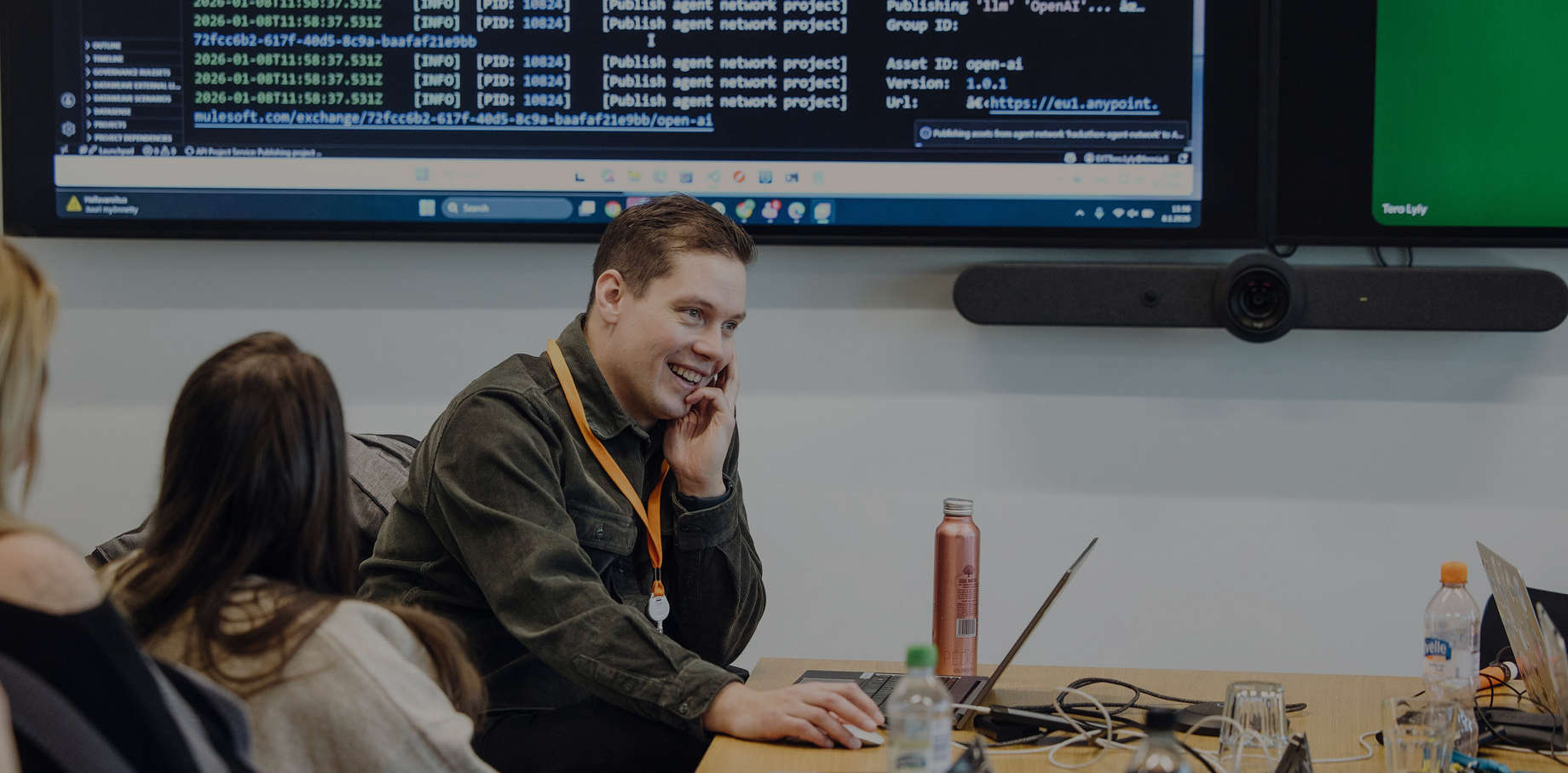
A hackathon with Fennia, MuleSoft and Tieto provided valuable learnings on building responsible AI architectures
In the future, managing AI agents will not be merely a technical concern, but a strategic choice that defines how effectively and securely organizations can leverage artificial intelligence.
AI agents are no longer just experimental initiatives. They are becoming deeply embedded in everyday business operations — collecting data, supporting decisions, and operating as part of increasingly complex processes. However, real value emerges only through consistent governance and orchestration. As agents are developed across different platforms and for multiple use cases, managing the overall landscape becomes increasingly complex. Without a clear architecture, automation risks remain fragmented, difficult to monitor, or even becoming a security liability.
When it comes to improving customer experience through new technologies, the insurance industry offers an excellent example. Processes are heavily regulated, data volumes are vast, and customer experience is critical. The goal is to build services that are as seamless and user-friendly as possible throughout the entire customer journey.
Fennia leads the way: a hackathon brought experts together
The search for solutions and new insights is continuous. Inspired by Salesforce’s Dreamforce event, Fennia wanted to approach the management of AI agents as concretely as possible by hosting a MuleSoft Agent Fabric hackathon in Espoo together with Salesforce and Tieto Tech Consulting. The hackathon brought experts from technology and business to the same table. The goal of the day was to explore how AI agents can be governed in a way that improves customer experience while adhering to sound architectural principles.
This is not about hype. It is about evaluating technologies from a customer-centric perspective against real processes and production environments. Managing AI agents is not just a technical exercise — it is a prerequisite for transparent and responsible automation.
When assessing the real applicability of AI agents in production environments, simply following concepts is not enough. Integration is essential. Without it, AI easily remains a detached experiment. Real value only emerges when AI is governed and connected to existing systems and accountability models.

Without integration, AI can easily remain a standalone experiment
To evaluate the true production readiness of AI agents, conceptual discussions alone are insufficient. The hackathon case focused on the automated handling of insurance claims. This process clearly encapsulates both the efficiency potential of the insurance industry, and the tangible value AI can deliver. Although the use case itself was hypothetical, it generated valuable insights and concrete input for further development. The hackathon quickly revealed what is already possible and where current architectures still set limitations.
In particular, the role of MCP (Model Context Protocol) and A2A (Agent2Agent) became clear. These define how AI agents interact with backend services and operate in a governed manner as part of an overall architecture.
“Without integration, AI can easily remain a standalone experiment. Real value is only realized when it is governed and connected to existing systems and accountability models,” Petman emphasizes.
The next step for AI agents: Governed control
AI agents can be built into many different products but managing them through a single platform enables a much more effective overall approach. This strengthens security, enables centralized lifecycle management of agents, and reduces the risk of data leakage.
When governance is embedded already at the architecture design stage, it becomes possible to build coherent, well‑controlled solutions.
“A governed approach enables component reuse, reduces unnecessary coding, and creates a clear path to production. Solutions can be developed as a whole — not as isolated points — which is critical from both a developer and a customer perspective,”
— Tero Lyly, Integration Architect, Tieto Tech Consulting
According to Lyly, a governed approach makes it easier to scale AI solutions in a sustainable way. By developing solutions as integrated wholes rather than disconnected implementations, organizations can ensure consistency, efficiency, and long‑term value — both for development teams and for customers.
MuleSoft Agent Fabric brings order to the agent ecosystem
MuleSoft Agent Fabric was introduced at Salesforce’s flagship event, Dreamforce. The same solution was also at the core of the hackathon. Designed for orchestrating and monitoring AI agents in enterprise environments, MuleSoft Agent Fabric aims to bring order to the rapid expansion of agents across organizations, where isolated agents are created on different platforms using different technologies, explains Vera Lindström, Strategic Account Director for Fennia at MuleSoft.
Salesforce’s Agentforce provides a platform for developing, deploying and managing agents. MuleSoft extends these governance and orchestration capabilities to include other agents across the organization, including also those that do not run on Agentforce. MuleSoft Agent Fabric operates as a technology‑agnostic layer, offering a centralized agent catalogue, advanced security and monitoring capabilities, and the ability to orchestrate agents built with different technologies.
As the number of AI agents continues to grow, the governance becomes just as critical for organizations as API management has been in the past. Visibility, discoverability and a clear governance model are essential: which agents are in use, who owns them, and what exactly they do. Agent behaviour must also be continuously monitored.
“The pace of change is remarkable. Jjust a year or two ago, the situation looked completely different. Technologies and standards are still evolving, but the direction is clear. We are moving from individual agents toward an ecosystem where agents and people work seamlessly together,”
— Vesa Kukkonen, Solution Engineer, MuleSoft
AI agents do not operate in isolation, however. The hackathon clearly demonstrated that governing AI agents requires close collaboration between multiple stakeholders, and all parties considered the experience a joint success.
The day was intense but highly inspiring. Ideas quickly materialized into concrete solutions, and at the same time we strengthened the maturity and viability of our MCP service concept, which will be launched this spring. The outcome was more than just a demo. It delivered valuable insights into architecture, integrations and the role of AI agents in future services.
In just one day, we created a prototype that would normally take months. And on top of that, working together was genuinely fun!
The hackathon felt like an intensive laboratory, where experts from different backgrounds dived into a shared challenge and solved it through close collaboration with our key customer, Fennia, and our partner, MuleSoft.