
How LTE and telecommunications engineers keep us online, in touch, and secure
Imagine trying to stream your favorite show, only for it to buffer every few seconds. Or having a video call with loved ones that freezes mid-sentence. Maybe, waiting endlessly for an online payment to go through. Sounds frustrating, right?
Thankfully, that’s not our reality today — and we have LTE (Long Term Evolution) and the tireless work of telecommunications engineers to thank for that.
Hi, I’m Artem Zagniy — and I help keep the world connected.
I work at Tieto as a Telecommunications Engineer for one of our long-term partners: BICS. BICS is a global leader in enabling secure and reliable mobile experiences. From voice calls to mobile data, it helps billions of people stay connected anytime, anywhere.
So, what exactly is LTE?
You’ve probably heard of 4G and 5G, but not so much about LTE. LTE stands for Long Term Evolution, and it revolutionized mobile internet when it was introduced back in 2008. It’s the technology that truly made 4G possible.
Thanks to LTE, you now can:
- Stream videos without buffering;
- Make smooth video calls;
- Play online games on the go;
- Download large files in mere seconds.
While early LTE wasn’t technically “true 4G,” it was so much faster than 3G that it got reflected in the name. With download speeds reaching up to 100 Mbps, LTE became the backbone of mobile connectivity — and still is today.
Why telecom engineers matter
Telecommunications engineers like me design, build, and maintain networks that power our digital lives. At the BICS project, the team enables everything from local phone calls to international video chats, secure messaging apps, and even those two-factor authentication texts you get when shopping online.
Personally, thanks to LTE, I can video call my friends in the Netherlands or chat with my grandma in Ukraine. It’s moments like these that remind me how vital stable telecom infrastructure is — not just for convenience, but for connection.
LTE: still relevant in a 5G world
Even as 5G expands, LTE remains essential. It covers wider areas, offers a reliable fallback when 5G isn’t available, and supports billions of devices, from smartphones to IoT systems and connected cars.
Here’s why LTE still matters:
- Lower latency and higher throughput than 3G;
- Operates on a dedicated spectrum with specialized hardware;
- Supports data, voice (VoLTE), messaging, and video over a single interface;
- Acts as a cost-effective bridge to 5G for industries and consumers alike.
The hidden backbone of modern society
Telecom engineers don’t just keep your phone working — we help governments, businesses, and individuals stay secure and informed. We design robust systems that support cybersecurity, emergency services, and global communication.
LTE uses advanced wireless technologies like OFDMA (orthogonal frequency-division multiple access) and MIMO (multiple-input and multiple-output) to efficiently handle massive data loads. It has become more than a tech standard and turned into a lifeline.
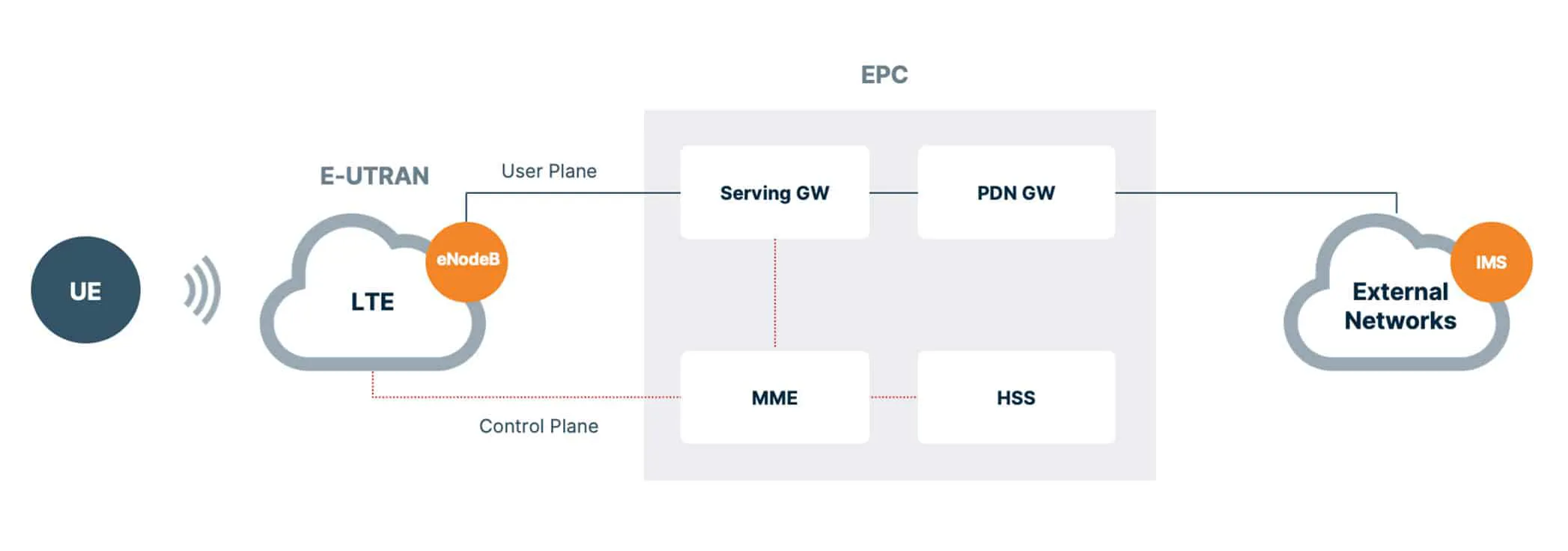
n the 4G LTE, User Equipment (UE) like smartphones or cellular devices, connects over the LTE Radio Access Network (E-UTRAN) to the Evolved Packet Core (EPC) and then further to External Networks, like the Internet. The Evolved NodeB (eNodeB) separates the user data traffic (user plane) from the network’s management data traffic (control plane) and feeds both separately into the EPC.
LTE plays an important role in the progression of wireless connectivity for both consumer and industrial use. While industries and IoT developers are exploring the capabilities of 5G, LTE technology continues to serve as an established and cost-effective option as a transition towards future advancements.
Let’s give credit where it’s due
Next time your video call is crystal clear or your payment goes through instantly, take a moment to appreciate the invisible network — and the engineers — making it all possible.
Because behind every smooth connection, there’s a team of people working hard to keep the world online.