
Тreat Trust as a human change problem, not a communications problem
People don’t resist AI because they don’t understand it. They resist it when it feels like something is happening to them quickly, quietly, and without a clear promise about the future. Responsible adoption starts with the human conditions that make good changes possible.
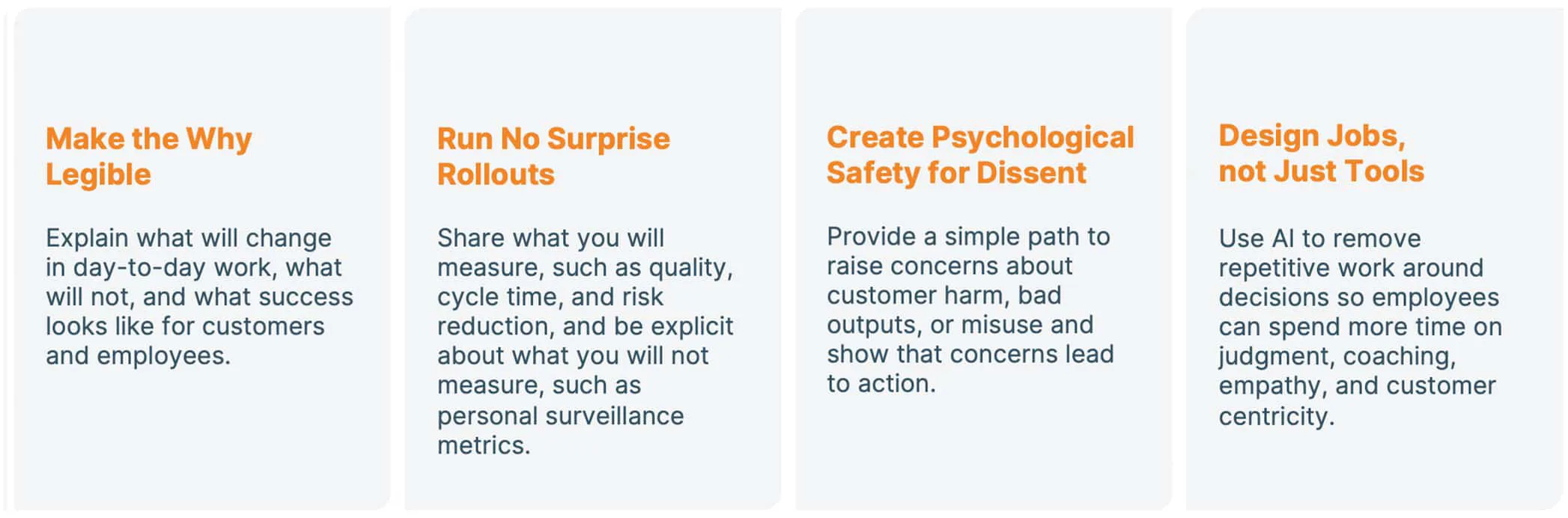
A good example of how AI can help your employees focus on more impactful work is through evidence gathering and reconciliation. When AI pulls supporting documentation, compares records across systems, and flags mismatches, audit and compliance teams can spend less time compiling and more time evaluating and advising.
Share the AI dividend without defaulting to layoffs
If employees assume that AI is a cost cutting program, you will pay for it through churn, lower adoption, and riskier workarounds. Responsible leaders treat efficiency gains as an AI dividend and decide in advance how to reinvest it. Here are reinvestment paths that build trust and support growth:
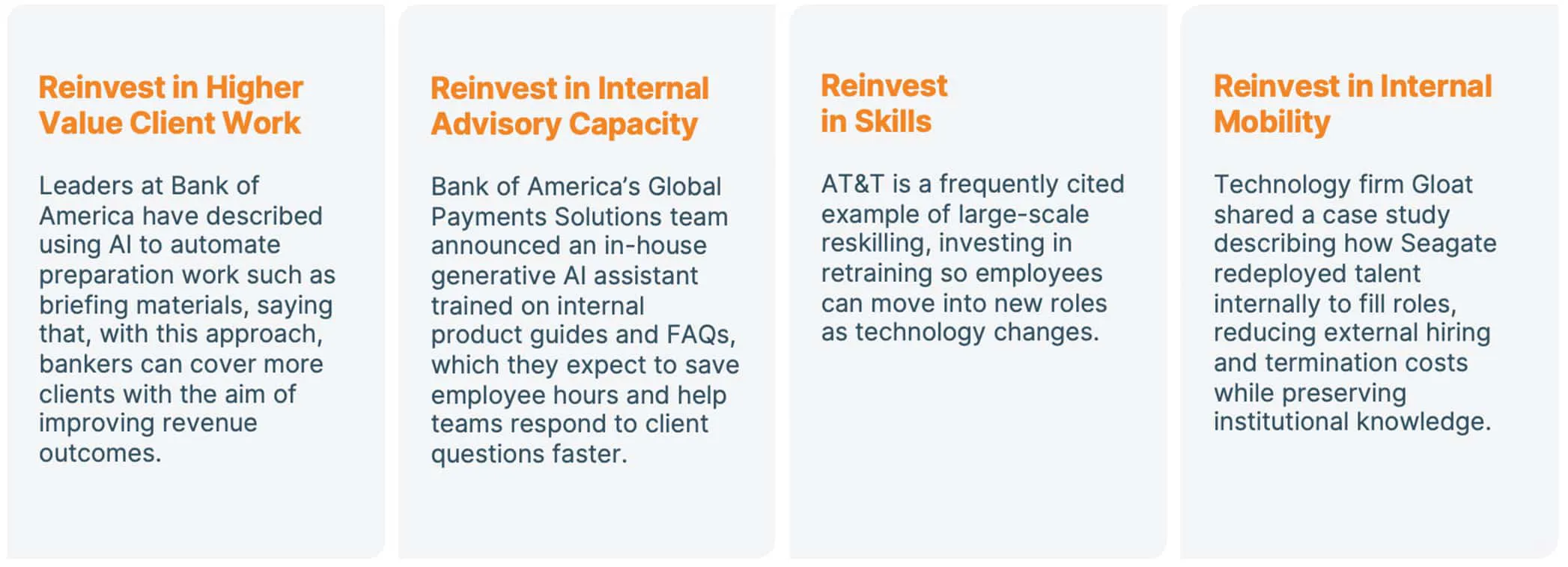
In banking terms, the promise is simple: automate the repetitive work so people can move into exceptions handling, quality review, fraud operations, advisory enablement, and customer advocacy. This is often safer, not just kinder, because it concentrates human judgment where it matters most.
Make sustainability a design requirement
AI has an environmental footprint. Computing, storage, data movement, and vendor choices all matter. Responsible adoption pairs two commitments: reduce the footprint of the AI you deploy and use AI-driven savings to create measurable benefits beyond your balance sheet.
A widely reported example comes from Google and DeepMind which used machine learning to reduce the energy used for data center cooling by up to 40 percent (15% reduction in overall PUE overhead).
The interesting part is how they did it, as it sparks practical ideas for organizations that run significant infrastructure:
- They trained an ensemble of deep neural networks on historical sensor data to predict future Power Usage Effectiveness.
- They trained additional ensembles to predict temperature and pressure, so recommended control actions stayed within safe operating constraints.
- They deployed the system as a decision layer that produced recommended setpoints, then validated results in live operations with the ability to toggle the automation on and off.
For financial institutions, the lesson isn’t to build a research lab. It’s to treat efficiency as an engineering outcome one can optimize. Many banks can apply the same thinking to data center operations, office and branch energy management, and scheduling compute-heavy batch jobs.
Some concrete steps that help the planet and reduce operating costs include:
- Build right-sized models: Smaller models often meet the need with lower latency and energy.
- Reduce data movement: Minimize duplication and unnecessary retrieval pipelines, especially for sensitive data.
- Adopt FinOps and GreenOps metrics: Track cost per outcome and energy per outcome as first-class release criteria.
- Use carbon-aware scheduling when feasible: Run batch inference and training in lower carbon regions or times when constraints allow.
- Add sustainability requirements to vendor selection: Including transparency into carbon and energy reporting
If you also want an explicitly altruistic example, consider how financial services can turn digital behavior change into real world restoration. Toronto Dominion, via MBNA, partnered with the Mastercard Priceless Planet Coalition to fund reforestation when eligible cardholders switched to paperless statements, supporting restoration of up to 30,000 trees in British Columbia and partnering with Tree Canada. The broader coalition aims to restore 100 million trees globally.
A bank-level AI dividend version of this idea is straightforward: commit a percentage of verified AI-driven savings to a transparent environmental or community program, then report those outcomes quarterly. This turns responsible adoption into a measurable story that employees can be proud of and that customers can trust.
Don’t lose the human parts of customer experience
The biggest reputational risks in AI are rarely technical. Instead, they come from moments where a customer feels dismissed, misled, or harmed. Financial institutions can protect trust by designing for human experience, not just accuracy.
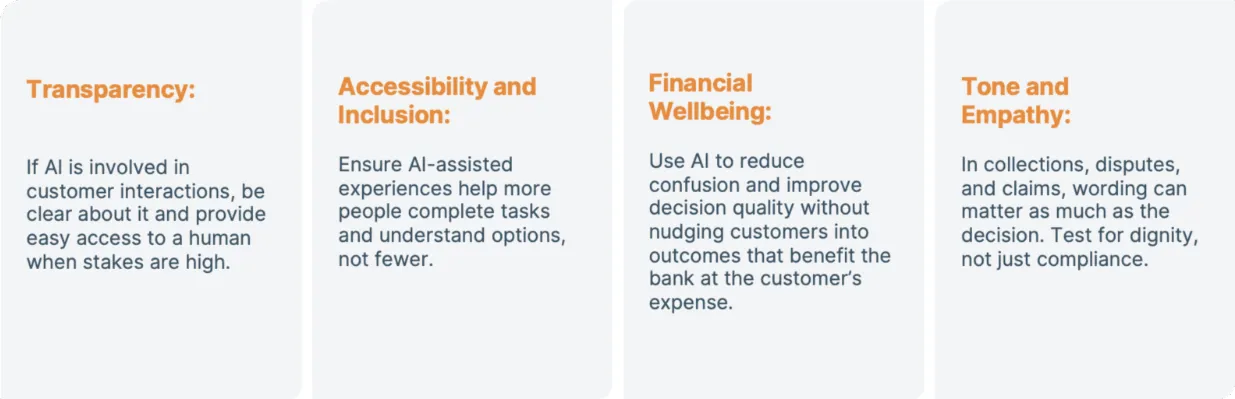
When teams design with these principles in mind, adoption becomes a trust multiplier. Employees can stand behind the experience because it aligns with the institution’s duty of care.
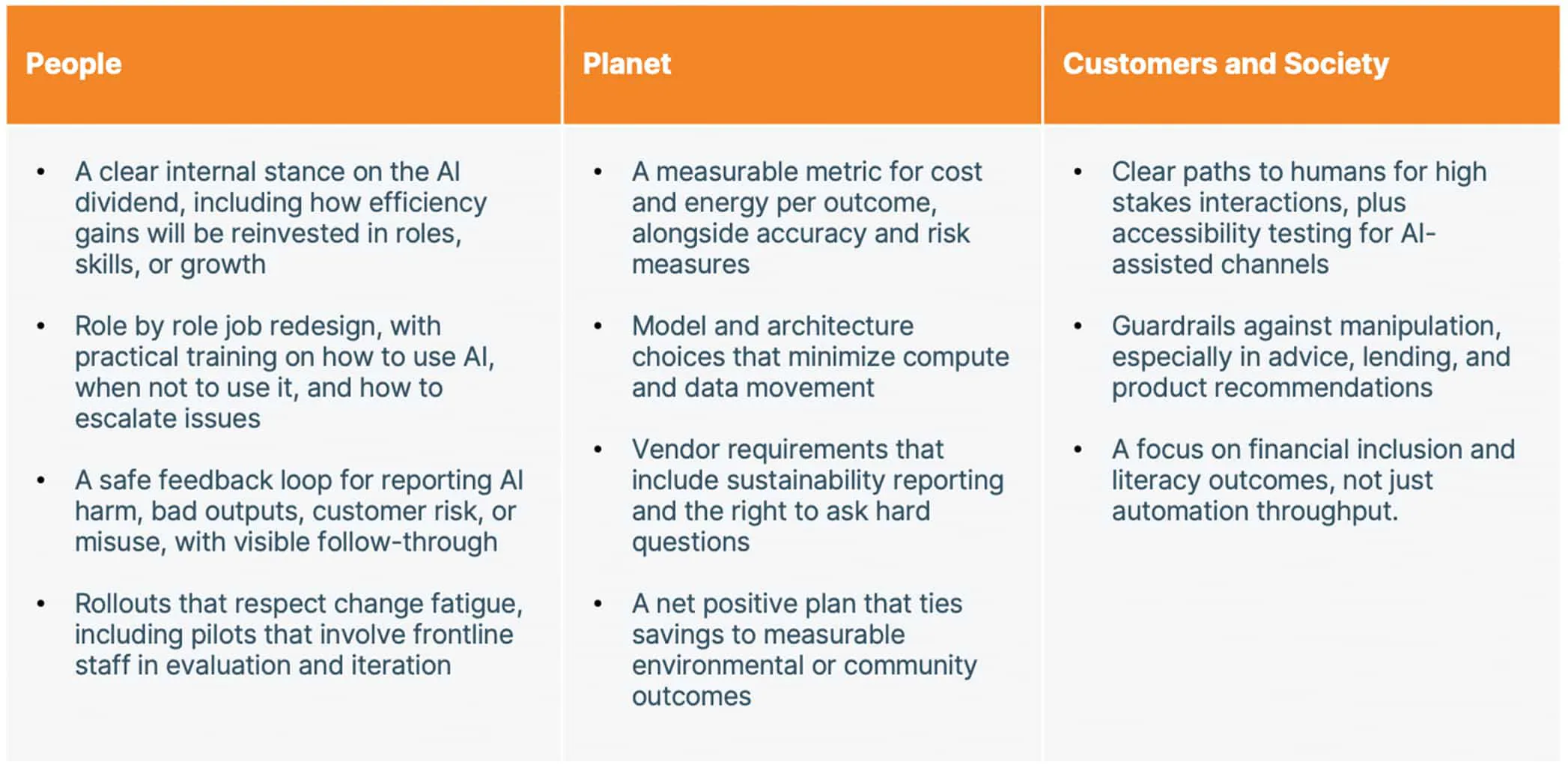
The responsible adoption checklist, people and planet edition
If you want a quick internal gut check that employees and ethical leaders can believe, look for the following signals.
How Tieto Tech Consulting helps financial institutions make this real
Tieto Tech Consulting helps banks and financial services leaders turn AI ambition into production outcomes that employees can trust and customers can rely on. We bring design-led delivery, applied AI engineering, and experience building regulated digital products.
In practice, that means we help teams identify high-value workflows, redesign jobs and experiences around human judgment, instrument systems to measure real outcomes, and build delivery patterns that scale. We also help leaders plan the reinvestment story, so the AI dividend becomes a retention and reputation advantage, not a morale drain.
If you are planning to scale AI in banking, ask this simple question: will you and your employees feel proud of the change one year from now? If the answer is not yet, the blueprint above is a practical place to start.